
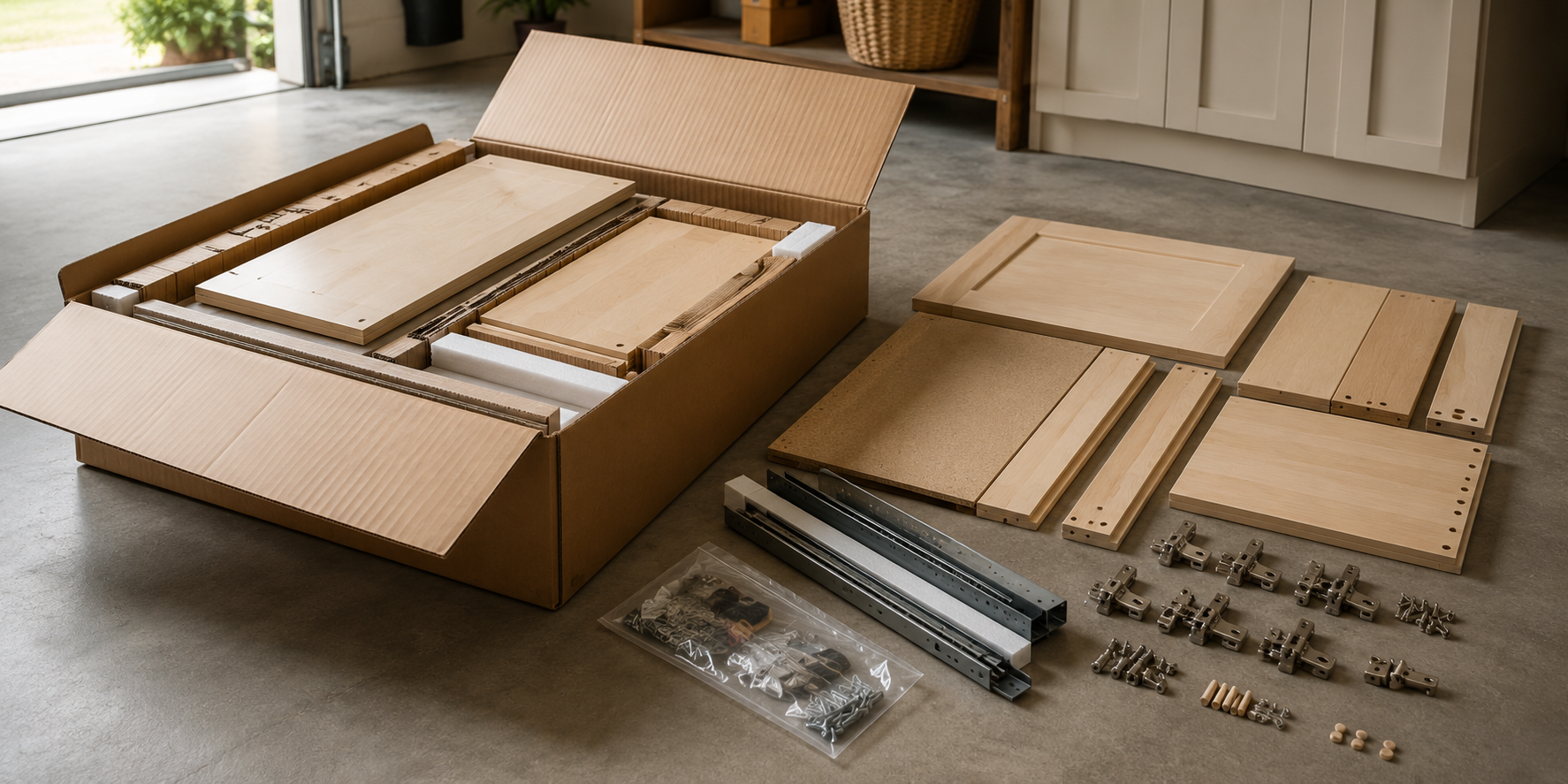
Say the letters “RTA” to most homeowners and you’ll watch their face change. Ready to assemble. Flat-pack. The mental image is instant — particleboard, an Allen wrench, a kitchen that looks fine for two years and falls apart by year five.
I need to clear something up, because that image is wrong for a huge amount of what’s actually sold as RTA today, including the cabinets I carry.
RTA describes how a cabinet ships and how it’s put together. It does not describe what it’s made of. Those are two completely separate questions, and the industry has let people confuse them for years because it’s easier to sell against a stereotype than explain the difference.
What RTA Actually Means
Here’s what RTA actually means: the cabinet box arrives flat or partially assembled, and final assembly happens on site — either by you, by your installer, or in some cases by the supplier before delivery. That’s it. That’s the whole definition. It says nothing about whether the cabinet is solid wood, plywood, or particleboard. It says nothing about the hardware, the joinery, or how long it’ll last.
The lines I carry — ROC, DL, AVA — are RTA in the shipping sense, and every one of them is all-wood construction with soft-close hardware as standard. That’s not a marketing claim, that’s what’s actually in the box. The particleboard-and-staples version of RTA that gives the category its bad name still exists out there, but it’s not what you’re getting from any line I sell.
Why RTA Exists — And Why It’s Actually Smart
So why does RTA exist at all, if it’s not about cutting corners? Cost and logistics. A fully assembled cabinet takes up enormous space to ship and is far more likely to get damaged in transit — corners chip, doors rack out of square, finishes scratch. Shipping a cabinet flat or knocked-down means more product fits on a truck, less gets damaged, and the savings get passed down the chain. Done right, RTA isn’t a compromise. It’s a smarter way to get the same quality cabinet to your kitchen for less money.
The One Thing RTA Requires From You
Where RTA actually requires more from you is assembly and installation. Someone has to put these boxes together correctly, square them, and hang them level. That someone needs to actually know what they’re doing — a poorly assembled RTA cabinet, even one made from excellent materials, will rack, the doors won’t align, and drawers will bind. This is exactly why I don’t just sell cabinets and walk away. Getting the right cabinet is half the job. Getting it assembled and installed correctly is the other half, and it matters just as much.
The Three Questions That Matter More Than the Label
If you take one thing from this chapter, take this: don’t judge a cabinet by whether it’s labeled RTA. Judge it by what it’s actually made of, what the hardware actually is, and who’s actually going to put it together. Ask those three questions of anyone selling you cabinets, RTA or not, and you’ll know more than most people walk into a showroom knowing.
Ready to Talk Numbers?
You’ve got the background on RTA. When you’re ready to see what your specific kitchen looks like in real dollars — send me your square footage and style direction and I’ll show you exactly where you land.